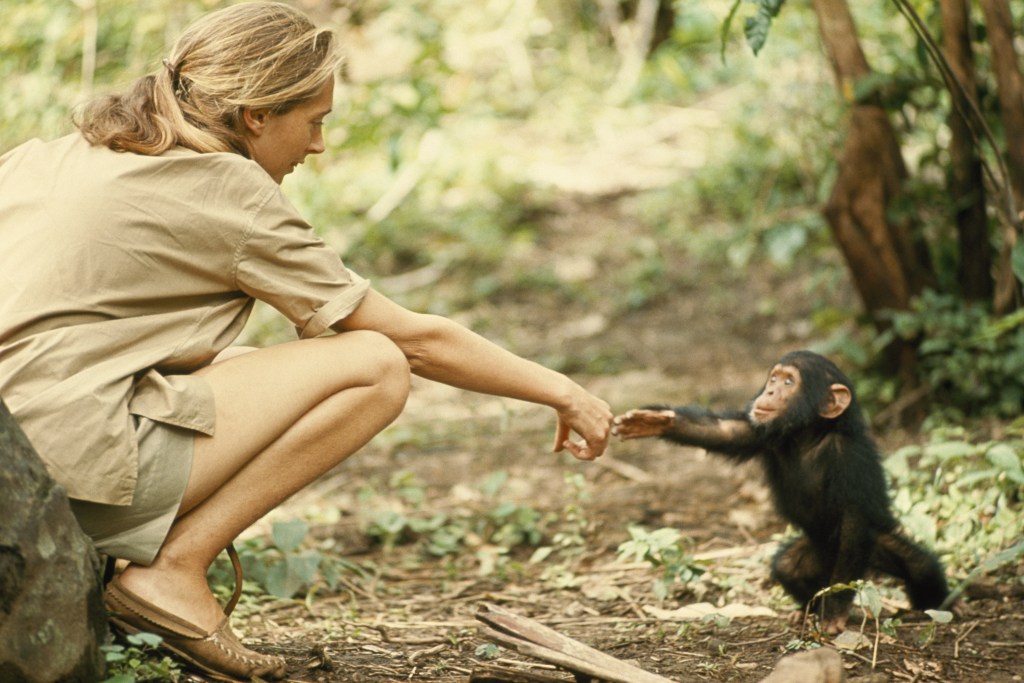
Jane Goodall died yesterday. The famed primatologist and anthropologist, revered chimpanzee expert and conservationist passed at the age of 91. It was of natural causes and occurred while she was traveling on a speaking tour advocating for global change, the betterment of all beings, and to inspire young minds in gaining a greater understanding and taking action on behalf of the natural world. She inspired hope. It was a life well lived and brimming with purpose.
Life has not been a straightforward path for me, Dear Reader. I grew up not knowing what I wanted to do or who I wanted to be. Whenever adults would ask me what I dreamed of doing when I grew up, I’d answer with whatever sounded good at the time – a chef (or “cooker” as I referred to it when I was 5 years old), a police officer, scientist, etc. Maybe it was due to a lack of self-awareness on my part, but I suspect that it was largely due to an aversion to simply dream. Not only did I grow up without knowing what I wanted to do, but I also grew up not knowing who I wanted to be. Thus my time as an aimless wanderer began.
I don’t think that it was necessarily any single individual’s fault. Parents and educators attempt to convey and assign purpose to their children all the time. Too often, they overlook the roles that they play by projecting their own values, hopes, and personal dreams onto malleable, young minds. It might look like enrolling your daughter into music lessons because you wish that you had learned as a child, teaching your son martial arts to toughen him up and to “learn to defend himself,” or lavishly supplying them with the attitude of how amazing a specific vocation would be for them. Suddenly it becomes their sole focus and there’s a fixation on meeting expectations – an assigned purpose. If you’re a parent, maybe you understand, but you don’t need to be to see this for what it is.
Positive and negative reinforcement through external rewards (praise, gifts, etc.) and punishment (shaming, reprimanding, demanding, etc.) creates attachment to approval from others. It isn’t wholly a bad thing in itself, but my invitation to you is to consider what ways of thinking are being created in others when you react and respond; about the roles that you play and how it affects perceptions of purpose and principles. Plus, speaking for myself, people don’t like to be told what to do.
Isn’t it more effective to bring an idea to life by making other people feel like it was their idea? The internal intrinsic value that is created from succeeding or learning from a challenge outweighs the value of a pat on the head with an “atta boy”. Bring to mind the immense satisfaction you have after doing a job well done. It could be after submitting a project at work that you spent long hours on or the relief after finally finishing that task that you had been avoiding to the point where it ruled your life. It could be as simple as having finished vacuuming your carpet. Shoot. “I’m the best vacuum-er around,” you might think. It could be the joy in learning to dance after years of saying, “I’m not a dancer.” The feeling of moving to music with intention, developed into moving to music because it calls to move through you.
Realization of what you can do is an invitation to believe in yourself and in what’s possible.

When I was in high school, my freshman year, I had a teacher who told me to my face that I was unremarkable. She looked me in the eye and commented that I was a B-level student, mediocre, and altogether only as impressive as my results. I didn’t care enough to acknowledge it back then, but those words cut deep. I was enrolled in what was referred to as a “gifted program” at the time, so it stood out to be told this by one of its core instructors. Despite being partially aware of my abilities at the time and my favorite 8th grade teacher declaring to the entire school at our middle school graduation that I was “a poet in hiding” not but a mere 3 months before, I took her words to heart. It followed me for a while, and I shook it off at some point, but that one negative experience shifted my entire trajectory for who I thought I was and altered my beliefs of who I wanted to be – I didn’t want to be the person who she saw. I wanted to be proud to be me.
Looking back, it was a negative experience yet also a fruitful one. Despite, even now, still lacking a crystal clear confirmation of my purpose in life, I at least have a better understanding of what having purpose feels like. Dear Reader, there is something valuable in understanding that “purpose” isn’t something that is assigned by the self or by another person. It is not something that can be taught. Having a sense of purpose is an inherent result of living life, taking chances, and reflecting on results and personal values.
What is the value in presenting “opportunities” to children instead of “options”? How do we show up like this for ourselves as adults?
It is common for people to assign themselves personal value and to establish their identity entirely around their careers. As I hope you’ve heard before, you are not what you do for a living. There is no right or wrong way of living life, save for a rule that I think we can all agree on.
- Do no harm to others.
But then again, is that always possible? Sometimes self defense calls for an irreversible result. Sometimes a job requires you to perform an ugly act. Sure, everything is choice, and there is practicality in exploring different ways to achieve goals and fulfill personal purpose without taking from others to advance in life. But can anyone truly be in control, or fully aware, of how their actions affect others? These are questions that tie directly into self actualization and are indeterminate of “purpose”.
Dear Reader, if you have already realized your own purpose in this world or if you’re unsure, take this moment to reflect. What calls to you? What makes you feel good about yourself? What inspires you and invokes curiosity? Is there such a thing as having a singular purpose? Can purpose change?

For the longest time I wanted to be a United States Marine. It became less of a hollow answer and more of a clear vision of what it would look like to have a career filled with rigid order, control and creative adaptation, valor and pride. I felt like it was my purpose but life didn’t take me there.
I made some choices after college that led me to work as a Program Area Director for a summer camp, then as a customer service representative at my city’s local aquarium for several years, an educator at the same aquarium for a season, a technical support specialist, and now a technical writer. I felt lost and sometimes still do. Asking myself what I want has yet to invoke a personal vision of anything other than being in love, having a family, being healthy, and creating a home that everyone looks forward to visit. I continue to imagine a full table of people, always with an empty seat for one more (just in case). It sounds simple when I compare my vision to some of the others that I’ve heard. But “Comparison is the thief of joy.” Right? My purpose isn’t entwined with a career (yet), but it could be. I could wake up every day with the satisfaction of knowing that what I do every day is good for the world (and get paid for it). Anything is possible, when viewed that way. There’s hope.
Jane Goodall, known for her groundbreaking studies of wild chimpanzees in Tanzania and blazing a trail for countless women in science is my inspiration to hope today. She once said:
“If we don’t have hope, then we tend to fall into apathy. And if we fall into apathy we tend to do nothing. Without hope, you’re not going to roll up your sleeves and get out there and do something to change the world. Because we are living in very dark times.” – Dr. Jane Goodall at a Forbes 30/50 Summit
Dr. Goodall admitted that, at times, she felt discouraged and depressed. She acknowledged experiencing moments of despair and discouragement, particularly in her later years regarding the state of the world and climate change. But she countered these feelings with action, focusing on local solutions, promoting hope, and inspiring others to contribute to positive change. She described such struggles as temporary, fueled by an obstinate refusal to give up and a strong belief in the the potential for individuals and communities to make a difference.
She created her purpose when she was 10 and decided that one day she would go to Africa, live with animals, and write books about them. As she worked to make that vision come true, she found another purpose that solidified her status as a legendary figure in the scientific and philanthropic community. She created the conservation organizations – the Jane Goodall Institute and Roots & Shoots. Her next purpose was to forward the next generations of young people. She said that what gave her hope was “young people who believed in a better future”. In an MSNBC 2023 interview, she shared that she wanted to live long enough to spread her message of conservation far enough around the world that her dream came true.
So what does all of that mean for you, Dear Reader? For the moments that you feel aimless and are questioning your purpose or are resharpening your own sense of purpose, look around and see where you can make a difference in your life or the life of others. Recognize that passions can change and often are born from simple beginnings.
Some of you may be asking, “But how can I help others when I can barely help myself? How am I supposed to find purpose in something that doesn’t inspire me?” To that, Dear Reader, I say:
First, you try. You try your genuine best.
Once you begin to try, you have entered the next step, you do.
I say this with love, so don’t over complicate it, just act. Your “best” does not mean “perfect”. It means that you do what you can with what you have (in body and spirit). Some days you might feel like you have 90% in the tank, pushing it to 100%, and some days you have 25%, and that’s all you can muster. 100% of 25% can still be your best. So, regardless of the difficulty and the end result, give yourself grace. Remember, that which is “simple” is not always “easy”.
And once you’ve tried, embrace the last step, you learn.
Learn that you can. Realize that you always could and now you see that you can. And if you were unsuccessful, reflect on that. What didn’t work? What feelings did that bring up in you? What does it inspire in you? Sometimes you’ll find your greater purpose in it and learn that purpose is waiting to move through you like music. So get curious and ask yourself, “What’s next?” Or if you’re Dr. Goodall, “Who’s next?”
Speaking for myself, I find purpose and reason for living through the observation of others. I crave to see beautiful moments in life. It is a serendipitous effect to be able to feel joy for others and to have involuntary, deep emotional responses from both witnessing and experiencing the world. And there are more forms of purpose that I have yet to discover for myself. I hope the same for you, Dear Reader. Perhaps you will be the next Goodall and someone will say that they want to be the next you.
It was only today, after reading about her passing, did I realize that what I do professionally (writing user manuals and help guides for a security company) does have purpose behind it. In actuality, I invented purpose for myself – I help people help people. Countless users read my material every day while installing or fixing security cameras and servers, deployed to deter crime, help homeowners secure their homes, and answering questions that users might be too embarrassed to ask. I support people through my personal writing which is powered by my own passions. Sometimes I help others accidentally on purpose.
In Dr. Goodall’s mind, the choice to pivot from focusing on what was lacking or lamenting on what has been getting in the way are speedbumps. When asked what she would say to young people who felt discouraged or on the verge of giving up, she replied:
“OK, you can’t save the world. No individual can. But what are you passionate about? Maybe it’s the plastic that’s killing wildlife, especially in the ocean. Maybe you want to plant trees so that you can withdraw more C02 from the atmosphere. Whatever it is, go to your local community, get some people with you and take action. And when you take action, you find you can make a difference.” – Dr. Jane Goodall
Purpose can be born from doing everyday things and it can exist without you seeing or realizing it. Remember what was said in my last post? Keep your chin up and heart open, Dear Reader.
Onward.

 Finding Ikigai
Leave a comment